
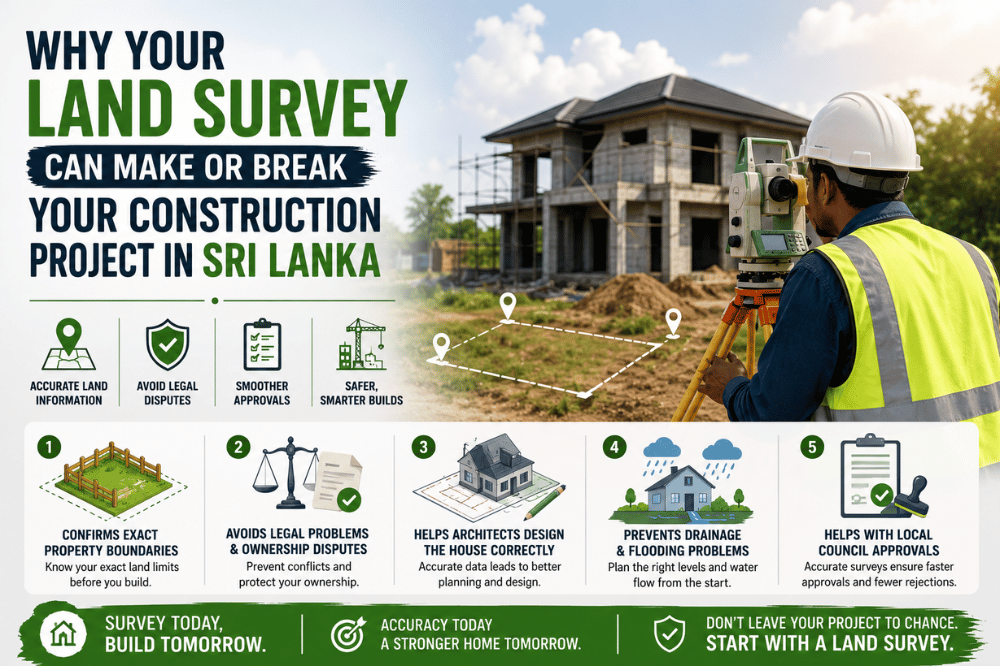
If you are planning to build a house in Sri Lanka, one of the most important steps you cannot afford to ignore is the land survey. Many construction problems, delays, and unexpected costs start from something as simple as inaccurate land information. From boundary disputes and council rejections to drainage issues and design mistakes, a small error in your survey can affect your entire project.
In this article, we break down why your land survey can truly make or break your construction project in Sri Lanka, so you can avoid costly mistakes and plan your build with confidence.
Reason 1: A Land Survey Confirms Your Exact Property Boundaries
One of the biggest reasons to get a land survey before construction in Sri Lanka is to confirm your exact property boundaries. Many homeowners assume the existing fences, walls, trees, or boundary markers already show the correct land limits, but that is not always true. In some cases, old survey plans may be inaccurate, damaged, or based on outdated measurements.
If your house foundation, boundary wall, septic tank, or driveway crosses into a neighboring property, it can create serious legal disputes and construction delays. Some homeowners only discover these problems after construction has already started, making the correction process expensive and stressful.
A professional land survey clearly identifies the exact size, shape, and boundary points of your land. This gives architects, contractors, and local authorities accurate information before any construction begins. It also helps prevent disagreements with neighbors and protects you from accidentally building outside your legal property limits.
For any construction project in Sri Lanka, accurate boundary confirmation is one of the most important first steps.
Reason 2: It Helps Avoid Legal Problems and Ownership Disputes
Land ownership disputes are more common in Sri Lanka than many homeowners realize. Problems often happen because of unclear deeds, inherited land divisions, overlapping survey plans, or disagreements between neighboring property owners. Starting construction without verifying your land details can lead to major legal issues later.
A proper land survey helps confirm that the land you plan to build on matches the legal documents and registered boundaries. It can also reveal access road issues, encroachments, and conflicts with nearby properties before construction begins. Identifying these problems early gives you time to solve them before investing large amounts of money into the project.
Legal disputes during construction can stop work completely and create costly delays. In serious cases, homeowners may even be forced to remove parts of a structure built on disputed land. Banks, lawyers, and local authorities also often request updated survey plans when approving loans, registrations, or building permits.
By completing a professional land survey first, you reduce legal risks and gain peace of mind before starting your construction project.
Reason 3: A Proper Survey Helps Architects Design the House Correctly
Architects rely heavily on accurate land survey data when designing a house. Without correct measurements, even a well-planned design can fail on site. A land survey provides key details such as exact land dimensions, shape, slope, and boundary positions, which directly influence how the house is planned.
In Sri Lanka, many plots are irregular in shape or have uneven terrain. If the architect does not have proper survey information, rooms may end up misaligned, setbacks may be violated, or the building may not fit properly within the land. This can lead to design changes during construction, which increases costs and delays the project.
Survey data also helps architects position the house in the best possible way for ventilation, sunlight, drainage, and access. For sloped land, contour information is especially important for designing foundations, split levels, or retaining walls.
With a proper land survey, architects can create accurate, realistic designs that match the actual site conditions, reducing the risk of errors and ensuring smoother construction from start to finish.
Reason 4: Land Surveys Help Prevent Drainage and Flooding Problems
Drainage and flooding issues are a common challenge in many parts of Sri Lanka, especially during heavy monsoon seasons. A proper land survey helps identify the natural slope and level differences of your land, which is essential for planning how rainwater will flow away from the building.
Without this information, houses may be built in low-lying areas where water naturally collects. This can lead to frequent flooding, damp walls, foundation damage, and long-term structural issues. Poor drainage planning can also cause water to flow toward neighboring properties, creating disputes and additional repair costs.
A land survey gives engineers and architects the data needed to design proper drainage systems, such as surface slopes, gutters, soakage pits, and stormwater channels. It also helps determine the best location for the house to minimize water-related risks.
By understanding the land’s natural behavior before construction starts, homeowners can avoid expensive water damage problems later. In short, a land survey ensures that drainage is planned correctly from the beginning, rather than being fixed after problems appear.
Reason 5: A Land Survey Helps With Local Council Approvals
Before starting construction in Sri Lanka, you must obtain approval from the relevant local council or Urban Development Authority (UDA), and a land survey is a key requirement in this process. Councils use survey plans to verify the exact size, boundaries, and layout of your land before they approve building plans.
If your survey is outdated, inaccurate, or inconsistent with your architectural drawings, your application can be delayed or even rejected. This often forces homeowners to redo plans, which adds extra time and cost to the project.
A proper land survey also helps authorities check whether your proposed building follows setback rules, access road requirements, and zoning regulations. These rules determine how close you can build to boundaries, roads, and neighboring properties.
In addition, survey documents ensure that the land is correctly registered and free from major encroachments or disputes. This makes the approval process smoother and faster.
In short, having an updated and accurate land survey increases your chances of getting quick council approval and prevents unnecessary delays before construction begins.
Reason 6: Surveys Reduce Construction Mistakes and Extra Costs
Construction mistakes are often expensive, and many of them start with incorrect or missing land information. A proper land survey helps contractors work with exact measurements, reducing the risk of errors during excavation, foundation setting, and structural layout.
Without an accurate survey, even small miscalculations can lead to major problems such as walls being built in the wrong position, foundations not aligning properly, or structures not fitting within the available space. Fixing these issues after construction has started usually requires demolition or redesign, which significantly increases costs.
A land survey also helps contractors plan material usage more accurately. This reduces waste and prevents unnecessary spending on adjustments during the building process. It also minimizes delays caused by on-site corrections and rework.
In addition, clear survey data improves coordination between architects, engineers, and builders. Everyone works from the same verified measurements, which keeps the project on track.
Overall, a land survey acts as a reliable foundation for accurate construction work, helping homeowners avoid costly mistakes and keep their budget under control.
Reason 7: It Protects the Long-Term Value of Your Property
A proper land survey plays an important role in protecting the long-term value of your property. When your land boundaries, size, and legal status are clearly documented, it becomes easier to sell, transfer, or develop the property in the future.
Buyers in Sri Lanka are increasingly careful about checking legal documents before making a purchase. If your land does not have an updated survey plan, it can reduce buyer confidence and lower the market value. In some cases, it may even delay or block a sale due to uncertainty about boundaries or ownership.
A clear survey also helps prevent future disputes with neighbors, which can negatively affect property value. Well-documented land is more attractive to banks as well, making it easier to secure loans or mortgages against the property.
In addition, when future development or renovations are needed, having accurate survey records makes the process faster and smoother.
Overall, a land survey is not just for construction. It is an investment in the long-term security and value of your property.
Additional Reasons Worth Mentioning
a. It Shows What You Can and Cannot Build on Your Land
A land survey is essential for understanding the real building limits of your property. Rules such as setbacks, Floor Area Ratio (FAR), and building height restrictions are all based on accurate land measurements. These rules are not flexible, and they directly control what your architect is allowed to design.
If the survey data is incorrect or missing, your design may include structures that are not legally allowed. This can lead to immediate rejection when submitted for approval, even before the local council properly reviews the full plan. In some cases, architects may need to redesign the entire project, causing delays and extra costs.
With a proper survey, you can plan your house within legal limits from the beginning, ensuring a smoother approval process and avoiding unnecessary revisions.
b. It Reveals Hidden Site Problems Beyond Flooding
Land surveys can also highlight hidden site conditions that are not obvious at first glance. In some plots, issues like contaminated fill, organic soil, or unstable ground conditions may exist beneath the surface. These problems can seriously affect construction safety and long-term stability.
According to building regulations in Sri Lanka, construction is not allowed on unsuitable soil unless it is properly treated or improved. If these issues are discovered only after construction begins, it can lead to foundation failures, structural damage, and very high repair costs.
By identifying such risks early, a land survey helps engineers plan the correct foundation type and any necessary ground improvements before building starts. This ensures a safer and more durable structure.
Signs You Need a New Land Survey Before Construction
Before starting any construction project, it is important to check whether your existing land survey is still accurate. In many cases, homeowners in Sri Lanka use old or incomplete survey plans, which can lead to serious problems during construction. If you notice any of the following signs, it is safer to get a new land survey before proceeding.
- Old Survey Plans with Unclear Measurements: If your survey plan is very old or the measurements are difficult to understand, it may no longer reflect the current condition of the land. Over time, land divisions, road expansions, or nearby construction can make old data unreliable.
- Changes to Neighboring Properties or Roads: When nearby land has been developed, subdivided, or when road boundaries have changed, your original survey may no longer be accurate. These changes can affect your boundary lines and access points.
- Uneven or Sloped Land: If your land has noticeable slopes or uneven ground, a fresh contour survey is important. This helps architects and engineers design proper foundations and drainage systems.
- Missing Boundary Markers: If physical boundary stones or markers are missing, damaged, or moved, there is a high risk of boundary confusion with neighbors. A new survey can clearly re-establish your property limits.
- Buying Inherited or Subdivided Land: Land passed down through inheritance or recent subdivision often has outdated or unclear documentation. A new survey ensures that what you own matches legal records.
- Starting a Major Renovation or Extension: Even if the original house was already built, any major extension or renovation should be based on updated survey data to avoid legal or structural issues.
In short, if there is any doubt about your land accuracy, a fresh survey is always a safer choice before construction begins.
How to Choose a Good Land Surveyor in Sri Lanka
Choosing the right land surveyor is just as important as getting the survey itself. A poor-quality survey can lead to legal issues, construction errors, and delays, so it is important to select a qualified and reliable professional. Here are some tips to consider making your choices:
- Check License and Experience: Always make sure the surveyor is licensed and recognized by relevant authorities in Sri Lanka. Experience also matters, especially in residential construction projects where accurate boundary and contour data is critical.
- Ask About Previous Residential Projects: A good surveyor should have experience working on housing projects. Ask for examples of similar work they have completed to ensure they understand residential requirements and local regulations.
- Confirm What Type of Survey Is Included: Not all surveys are the same. Some include only boundary details, while others include contour levels, access roads, and site features. Make sure you clearly understand what you are paying for.
- Compare Pricing and Deliverables: Do not choose based on price alone. Compare what each surveyor offers, including reports, drawings, and accuracy level. A slightly higher cost may provide much better value.
- Ask About Timelines and Updated Survey Plans: Construction schedules are important, so confirm how long the survey will take and whether you will receive an updated, clear survey plan suitable for approvals.
- Importance of Working With Trusted Professionals: A reliable surveyor ensures accuracy, legal safety, and smooth approval processes. Working with trusted professionals reduces risks and gives you confidence before starting construction.
Common Mistakes Homeowners Make With Land Surveys
Many construction problems in Sri Lanka happen not because of design issues, but because of avoidable mistakes made during the land survey stage. Being aware of below mistakes can help homeowners prevent costly delays and legal trouble.
- Using Outdated Survey Plans: One of the most common mistakes is relying on old survey plans. Land conditions, boundaries, and nearby developments may have changed over time, making old data unreliable for new construction projects.
- Hiring Unqualified Surveyors: Choosing a surveyor based only on low cost can be risky. Unqualified or inexperienced surveyors may produce inaccurate measurements, leading to boundary disputes, approval issues, and construction errors.
- Ignoring Contour and Drainage Details: Some homeowners focus only on boundaries and ignore land levels. Without contour and drainage information, buildings may face flooding, waterlogging, or foundation problems later.
- Starting Construction Before Final Survey Approval: Starting work before confirming the final survey results can cause major issues if corrections are needed later. This often leads to redesigns or even partial demolition.
- Failing to Verify Boundary Points With Neighbors: Not discussing boundary markings with neighbors can lead to disputes during or after construction. Verifying boundaries early helps avoid misunderstandings and legal conflicts.
Avoiding these mistakes ensures a smoother, safer, and more cost-effective construction process from the beginning.
Need Help on Building Your Dream Home?
At Hello Builders, we specialize in turning your vision into reality with high-quality construction, modern designs, and expert project management. From luxury villas to contemporary homes, we handle every step of the process with professionalism and attention to detail.
Here’s why Hello Builders is the trusted choice for homeowners in Sri Lanka:
- Expertise & Quality: We use certified materials and follow best practices to ensure your home is safe, durable, and stylish.
- Comprehensive Services: Architectural design, structural engineering, interior solutions, council approvals, and full project management(all under one roof).
- Customer-Focused Approach: We work closely with you to bring your dream home to life while respecting your budget and timeline.
Take the first step toward your perfect home today. Click below to get in touch with our team!
| Contact Us |
Final Thoughts
A land survey is not just a technical step before construction—it is the foundation of your entire building project. From confirming your exact property boundaries and avoiding legal disputes to helping architects design accurately and ensuring proper drainage, every stage of construction depends on correct land information. Even small errors in a survey can lead to costly delays, council rejections, design changes, or long-term structural issues.
As seen throughout this article, a proper land survey also plays a key role in reducing construction mistakes, controlling unexpected costs, and protecting the long-term value of your property. It even helps you understand what you are legally allowed to build and reveals hidden site conditions that could affect safety and stability.
In simple terms, skipping or rushing your land survey can put your entire project at risk. On the other hand, investing in a reliable and accurate survey early gives you clarity, confidence, and a smoother construction process from start to finish. For anyone planning to build in Sri Lanka, this is one step that should never be treated as optional.
Key Takeaways
- A land survey confirms the exact boundaries of your property and prevents accidental encroachment onto neighboring land.
- It helps avoid legal disputes and ownership conflicts that can delay or stop your construction project.
- Architects depend on accurate survey data to design a house that properly fits the land and follows regulations.
- A proper survey helps identify land slope and drainage flow to reduce the risk of flooding and water damage.
- Local councils and UDA approvals often require an updated land survey before reviewing building plans.
- Accurate survey data reduces construction errors, rework, and unnecessary extra costs during the building process.
- A land survey helps protect and increase the long-term value and resale potential of your property.
- It defines legal building limits such as setbacks, FAR, and height restrictions before design begins.
- Surveys can reveal hidden soil or site issues that may affect foundation safety and structural stability.
- Choosing a licensed and experienced surveyor is essential to ensure accurate results and smooth project approval.
FAQs
What happens if you skip a land survey in Sri Lanka?
Skipping a survey can lead to wrong setback distances, misaligned foundations, and permit rejections. You may also unknowingly build on disputed land or over drainage lines. In serious cases, authorities can issue stop orders or require partial demolition, turning a manageable project into a costly and stressful legal problem.
What type of land survey do I need for a construction project in Sri Lanka?
Most residential projects need two surveys: a boundary survey to confirm property lines and a topographic survey to capture land levels and existing features. Larger developments may also require cadastral or utility-location surveys. Always confirm with your architect and local authority which survey types are needed before your building plan submission.
How early in the project should I arrange a land survey?
Arrange your land survey immediately after purchasing the land and before finalizing any architectural or structural designs. Doing it at this stage means all your plans are based on real site conditions. It also ensures your first building permit submission includes correct survey documents, avoiding delays right from the start.