
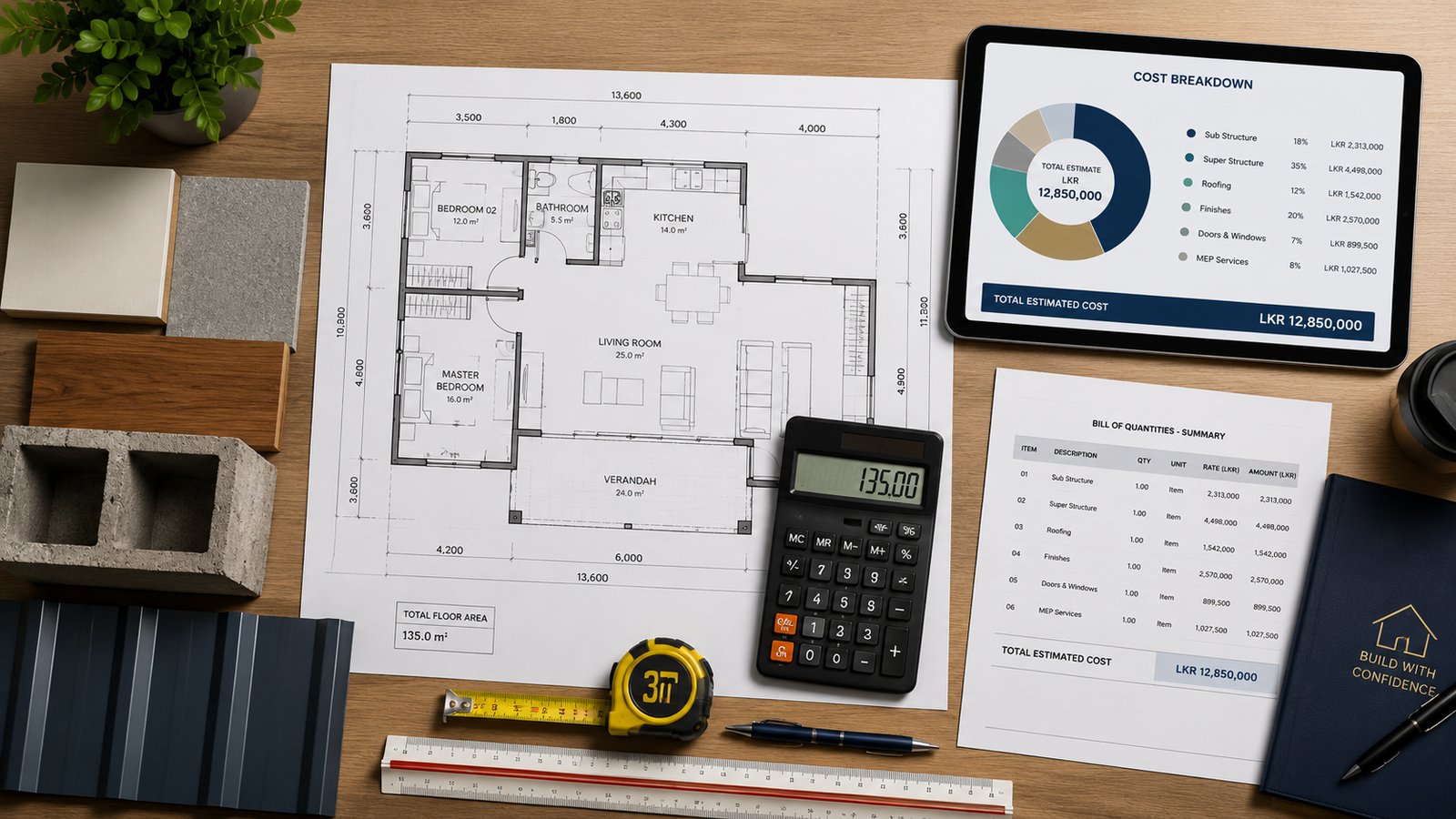
If you've been researching the 1 sq ft construction cost in Sri Lanka, you've probably noticed that the numbers vary dramatically from one source to another. Some homeowners receive quotes that are thousands of rupees apart for houses of a similar size, leaving them confused about what the actual cost should be.
The truth is that there is no single cost per square foot that applies to every project. Factors such as finish level, location, foundation requirements, roof design, material choices, and additional systems all play a major role in determining the final price.
In this article, we'll break down the 7 key reasons why construction costs vary so widely in 2026, helping you understand what really drives your budget and how to estimate your project more accurately.
Reason 1: Finish Level (Basic vs Mid-Range vs Luxury)
The finish level is the single biggest reason two houses of the same size can have completely different price tags. In 2026, this one factor alone can push your cost per sq ft up by three or four times.
- Basic Finish (Rs. 5,500 - Rs. 10,000 per sq ft): This covers cement flooring, standard doors and windows, basic bathroom fittings, and simple electrical work. It gets the structure livable but keeps everything functional rather than decorative.
- Mid-Range Finish (Rs. 10,000 - Rs. 15,000 per sq ft): At this level, you get tiled flooring, better quality doors and windows, branded bathroom fittings, and slightly upgraded electrical and plumbing work. Most middle-class homes in Sri Lanka fall into this bracket.
- Luxury Finish (Rs. 13,000 - Rs. 22,000+ per sq ft): This includes imported tiles or natural stone flooring, high-end sanitaryware, premium kitchen fittings, false ceilings, and custom joinery. Full AC provisions and smart home wiring often get added here too.
The gap between basic and luxury isn't just paint and tiles. It reflects the quality of materials used behind the walls, the skill level of the labor hired, and how much customization goes into every room. Before fixing a budget, decide which bracket you're actually building in, as it changes every number that follows.
Reason 2: Location of the Land
Where you build changes your cost per sq ft as much as what you build. Colombo, Kandy, and Galle carry the highest construction rates in the country, while outstation areas can come in noticeably cheaper for the exact same design.
A few things drive this gap. Labor is more expensive in and around Colombo simply because demand is higher and skilled workers charge more to work in the city. Material transport also adds up. If a supplier has to truck cement, sand, or steel further out to a rural site, that cost gets passed on to you, though sites closer to quarries or brick kilns can sometimes work out cheaper than expected.
Site access matters too. Even within the same district, a plot with a narrow entrance, a steep slope, or a location deep inside a housing scheme without proper road access will cost more, since machinery and material delivery become harder. Contractors often factor this in before quoting.
Urban plots also tend to be smaller and tightly packed between neighboring walls, which limits how a contractor can work and can slow down construction, indirectly raising labor cost per sq ft.
Before comparing quotes from different builders, check whether their base rate already reflects your specific location. A rate calculated for a flat, accessible plot in a semi-urban area won't hold up on a hillside site in Kandy.
Reason 3: Foundation Type and Soil Condition
The ground beneath your land plays a bigger role in your final cost than most people expect. Two plots in the same neighborhood can need completely different foundations, and that alone can shift your cost per sq ft by a wide margin. Here's what you need to know, in general:
- Rock foundation:If your land sits on solid rock, you're in the best position. Rock foundations are generally the most affordable option since they need less excavation and material to build a stable base.
- Soft soil foundation: Soft or loose soil needs deeper excavation, more concrete, and stronger reinforcement to prevent the structure from settling over time. This pushes costs up compared to building on rock.
- Pile foundation: On very soft, marshy, or unstable ground, a pile foundation becomes necessary. Piles are driven deep into the ground to reach a stable layer, and this method is by far the most expensive of the three.
- Foundation cost range: Across these three types, foundation work typically falls between Rs. 2,500 and Rs. 4,000 per sq ft, and it's one of the largest cost categories in the entire build.
The only way to know which type your land needs is a proper soil test. Skipping this step and guessing the foundation type is one of the most common reasons budgets go wrong.
Reason 4: Roof Design (Pitched vs Box-Type/Flat Roof)
The type of roof you choose affects more than just the look of your house. It changes the structural work involved, and that shows up directly in your cost per sq ft. Here's how the two options compare:
- Pitched roof: A sloped, conventional roof is the more affordable option. It uses lightweight roof sheets or tiles and needs simpler waterproofing, which keeps both material and labor costs lower.
- Box-type (flat) roof: A flat roof gives a modern look but comes with a higher price tag. It needs a heavier concrete slab to bear the load, along with a more complex waterproofing membrane system to prevent leaks over time.
- Cost difference: Box-type builds typically cost 10-15% more per sq ft than pitched-roof houses. For example, a 2,000 sq ft standard-finish pitched roof house may cost around Rs. 14,000,000, while the same house with a box-type roof could reach Rs. 16,000,000.
- Why the gap exists: The extra cost comes from the heavier slab load, the additional steel and concrete needed, and the specialized waterproofing work that flat roofs demand to stay leak-free in Sri Lanka's climate.
If you're working with a tight budget, a pitched roof is the safer choice. If the flat-roof look matters to you, plan for the extra cost upfront rather than being surprised by it later.
Reason 5: Design Complexity
A simple floor plan and a complex one can carry very different price tags, even with the same finish level and floor area. Design decisions made on paper directly affect how much time, labor, and material the build eats up.
- Simple rectangular plan: A straightforward, box-shaped layout is the most cost-efficient option. It uses standard-sized materials with minimal cutting or wastage, and construction moves faster since there are fewer technical challenges to work around.
- Curves, cantilevers, and multiple levels: Custom architectural features like curved walls, cantilevered sections, split levels, or double-height spaces demand specialized formwork, extra reinforcement, and more skilled labor. Each of these adds cost that a simple design would never require.
- Material wastage: Complex shapes and angles almost always mean more offcuts and leftover material that can't be reused elsewhere on site. This wastage adds up quickly across a full build.
- Labor time: Intricate designs take longer to execute correctly. Skilled masons and carpenters spend more hours on detailing work, and that extra time gets reflected in the final labor cost.
If your budget is a priority, keeping the layout simple is one of the easiest ways to control cost per sq ft without compromising on space or function. Save the complex features for areas where they'll matter most.
Reason 6: Materials and Supplier Choice
What you build with, and who you buy it from, can swing your cost per sq ft as much as any structural decision. Two houses with the same design can end up with very different price tags purely based on material sourcing.
- Local vs imported materials: Locally manufactured cement, bricks, and sanitaryware cost less and are easier to source without delays. Imported materials like certain tiles, fittings, and fixtures carry higher price tags due to shipping, duties, and currency exchange, but they often come with a different finish or durability standard.
- Brand-level price gaps: Even within the same material category, prices can vary widely by brand. Cement, tiles, sanitaryware, and electrical fittings all have budget, mid-range, and premium brand options, and choosing between them can change your total cost significantly without changing the design at all.
- Bulk buying and supplier relationships: Contractors who buy materials in bulk or have established relationships with suppliers can often secure better rates than an individual homeowner buying in small quantities. This is one reason working with an established construction company can bring down material costs.
Material choice is one of the few areas where you have direct control over cost. Deciding early which materials matter most to you, and where you're willing to go with a more affordable option, makes a real difference to your final budget.
Reason 7: MEP and Add-On Systems (Electrical, Plumbing, AC, Solar)
MEP stands for Mechanical, Electrical, and Plumbing, and it's one of the most overlooked cost factors when homeowners plan a budget. These systems sit behind the walls and under the floors, but they can add a significant amount to your cost per sq ft.
- Basic wiring and plumbing: A standard setup covers essential electrical points, lighting, and plumbing lines needed to make the house functional. This is the baseline cost included in most basic and mid-range finish estimates.
- Full air conditioning provisions: Adding AC to every room means extra wiring, dedicated circuits, and sometimes structural adjustments to accommodate outdoor units and piping. This isn't included in standard estimates and needs to be budgeted separately.
- Solar power systems: Solar panel installations add upfront cost but can reduce electricity bills over time. The price depends on system capacity and whether it's a hybrid or fully off-grid setup.
- Smart home features: Smart lighting, automated security, and app-controlled systems require additional wiring and equipment during the construction stage itself, since retrofitting later is far more expensive.
- Essential vs optional: Basic wiring and plumbing are non-negotiable. AC, solar, and smart home systems are optional additions that homeowners choose based on budget and lifestyle needs.
These add-ons are easy to underestimate because they don't show up in the structure itself. Deciding which systems you want before construction starts, rather than adding them midway, keeps both cost and rework to a minimum.
Quick Cost Comparison Table
Here's how everything comes together at a glance:
| Factor | Cost Impact per Sq Ft | Key Driver |
| Finish Level - Basic | Rs. 5,500 - Rs. 10,000 | Cement flooring, standard fittings |
| Finish Level - Mid-Range | Rs. 10,000 - Rs. 15,000 | Tiled flooring, branded fittings |
| Finish Level - Luxury | Rs. 13,000 - Rs. 22,000+ | Imported materials, custom joinery |
| Location - Outstation | Lower base rate | Cheaper labor, easier material access |
| Location - Colombo/Kandy | Higher base rate | Urban labor and transport costs |
| Foundation - Rock | Rs. 2,500 - Rs. 4,000 | Least excavation needed |
| Foundation - Soft Soil | Higher within range | Deeper excavation, more reinforcement |
| Foundation - Pile | Highest within range | Deep piling on unstable ground |
| Roof - Pitched | Base rate | Lightweight sheets, simpler waterproofing |
| Roof - Box-Type (Flat) | +10-15% over pitched | Heavier slab, complex waterproofing |
| Design - Simple | Lower labor/material cost | Less wastage, faster build |
| Design - Complex | Higher labor/material cost | Custom formwork, more skilled labor |
| Materials - Local | Lower cost | Easier sourcing, no import charges |
| Materials - Imported | Higher cost | Shipping, duties, currency exchange |
| MEP - Basic | Included in base estimate | Standard wiring and plumbing |
| MEP - AC/Solar/Smart Home | Added on top | Extra wiring, equipment, structural work |
This table gives you a rough starting point, but your actual cost per sq ft depends on how these seven factors combine on your specific project. The only way to get an exact figure is a site visit and a proper Bill of Quantities.
How to Get an Accurate Estimate for Your Home Building Project in Sri Lanka?
The seven reasons above explain why prices vary so widely, but they also mean no online figure can tell you exactly what your home will cost. Getting an accurate number takes a few concrete steps:
- Site visit and soil test: This confirms your foundation type and identifies any access or land challenges before pricing begins. Skipping this step is why many budgets go wrong later.
- BOQ (Bill of Quantities) from a contractor: A proper BOQ breaks down every material, quantity, and labor cost specific to your design. This is the only way to move from a rough estimate to a real number.
Want an Accurate Cost Estimate for Your Home?
Every one of the 7 factors above plays out differently depending on your land, your design, and your finish preferences. The only way to know your real cost per sq ft is a proper site visit and a detailed BOQ, and that's exactly where we come in.
At Hello Builders, we handle the full process so you get pricing that's accurate from day one, not a guess you'll have to revise mid-build:
- Expertise & Quality: We use certified materials and follow best practices to ensure your home is safe, durable, and stylish.
- Comprehensive Services: Architectural design, structural engineering, interior solutions, council approvals, and full project management, all under one roof.
- Customer-Focused Approach: We work closely with you to plan a cost per sq ft that fits your budget and timeline, with no hidden surprises along the way.
Get a free site visit and a clear, accurate quote for your project. Click below to get in touch with our team.
| Contact Us |
Conclusion
The biggest takeaway is that there is no fixed 1 sq ft construction cost in Sri Lanka that applies to every project. The final cost depends on a combination of factors, including your finish level, land location, soil condition, roof type, design complexity, material choices, and any additional systems such as air conditioning, solar power, or smart home features.
This is why two houses with the same floor area can have vastly different construction costs in 2026. While cost-per-square-foot figures can provide a useful starting point, they should never be treated as an exact budget. The most reliable way to determine your actual construction cost is through a site visit, soil assessment, and a detailed Bill of Quantities (BOQ) prepared specifically for your project.
By understanding these seven cost drivers before you start building, you can make informed decisions, avoid unexpected expenses, and plan a home that matches both your needs and your budget.
Key Takeaways
- There is no single 1 sq ft construction cost in Sri Lanka because every project has different requirements.
- The finish level is one of the biggest factors affecting construction costs, with luxury finishes costing significantly more than basic finishes.
- Land location influences costs through differences in labour rates, material transport expenses, and site accessibility.
- Soil conditions and foundation requirements can greatly increase the total construction budget.
- Box-type (flat) roofs generally cost more than pitched roofs due to additional structural and waterproofing requirements.
- Simple house designs are usually more cost-effective than complex layouts with custom architectural features.
- Material selection, including local versus imported products, has a direct impact on the cost per square foot.
- Contractor supplier networks and bulk purchasing arrangements can help reduce material costs.
- Additional systems such as air conditioning, solar power, and smart home features can substantially increase overall construction expenses.
- A site visit, soil test, and detailed Bill of Quantities (BOQ) are essential for obtaining an accurate construction cost estimate.
FAQs
What is the average 1 sq ft construction cost in Sri Lanka in 2026?
It ranges from Rs. 5,500 for basic finish to over Rs. 22,000 for luxury finish. Most mid-range homes fall between Rs. 10,000 and Rs. 15,000 per sq ft. The exact figure depends on finish level, location, foundation type, roof design, and material choices.
What factors affect construction cost per square foot in Sri Lanka?
Seven main factors drive the price: finish level, land location, foundation and soil condition, roof design, design complexity, material and supplier choice, and MEP systems like AC, solar, and smart home wiring. Each one can shift your cost per sq ft independently.
Does location really change the cost that much?
Yes. Colombo, Kandy, and Galle carry higher rates due to labor demand and material transport costs. Site access also matters. A plot with poor road access or a steep slope costs more to build on, even within the same district.
Is box-type or pitched roof cheaper to build?
Pitched roofs are cheaper. They use lightweight sheets and simpler waterproofing. Box-type (flat) roofs cost 10-15% more per sq ft due to heavier concrete slabs and complex waterproofing membrane systems needed to prevent leaks in Sri Lanka's climate.
What is included in the per square foot construction cost?
It typically covers structural work, foundation, roofing, walls, basic electrical and plumbing, doors, windows, and flooring based on your chosen finish level. It doesn't usually include land cost, council approval fees, or optional add-ons like AC and solar systems.
Does 1 sq ft construction cost include land cost?
No. The cost per sq ft only covers construction, materials, and labor. Land price is calculated separately, per perch, and varies widely by district, from around Rs. 50,000 to Rs. 30 million per perch in prime areas like Colombo.
How can I reduce my construction cost per sq ft?
Keep the design simple and rectangular, choose a pitched roof over a flat one, use locally sourced materials where possible, and avoid unnecessary customization. Never compromise on foundation quality, though, since it affects your home's long-term safety.
How accurate are online construction cost calculators?
They give a useful starting estimate but aren't exact. Calculators can't account for your specific soil condition, site access, or design details. For an accurate figure, you need a site visit, soil test, and a detailed Bill of Quantities (BOQ).