
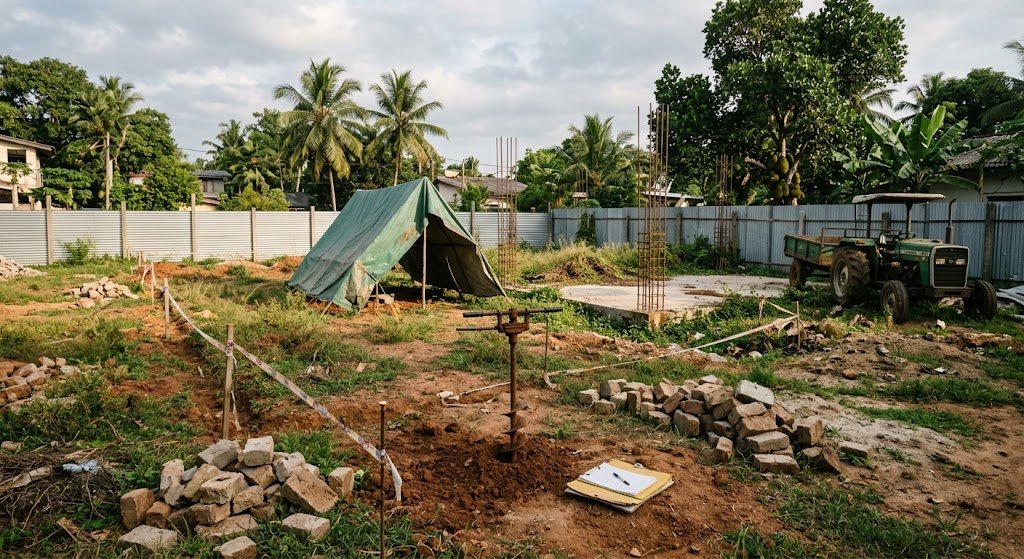
Most house construction failures in Sri Lanka don't happen on the construction site. They happen before it, in decisions made during land buying, planning, and contractor selection, long before the first brick is laid. A cracked foundation, a stalled project, or a budget that spirals out of control can usually be traced back to a step that was skipped or rushed at the very beginning.
If you're planning to build a home, understanding these early mistakes can save you from the stress, delays, and unexpected costs that catch so many homeowners off guard. In this article, we'll walk through 7 reasons house construction projects in Sri Lanka fail before they even start, and what you can do differently to avoid each one.
Whether you're just starting to look for land or already have a design in hand, this guide will help you build with more confidence and fewer surprises.
Reason 1: No Proper Land or Soil Check Before Buying
Many homeowners in Sri Lanka fall in love with a plot because of its location, price, or view, without ever checking what lies beneath it. This is often the first mistake, and it happens before construction even begins.
Every piece of land has different soil conditions. Some areas have firm, stable ground, while others have clay, loose fill, or expansive soil that shifts with moisture. Without a proper soil test, usually done through boreholes and lab analysis, you have no way of knowing the bearing capacity of your land or what kind of foundation it actually needs.
Skipping this step can lead to serious problems later: cracked walls, an uneven floor, poor drainage, or a foundation that costs far more to fix than it would have to build correctly the first time. Sloped land, low-lying areas prone to flooding, and poor road access can also raise construction costs significantly.
A soil test typically costs a small fraction of your total budget, yet it determines the safety and stability of your entire home. Skipping it to save money early almost always costs more later, sometimes in ways that can't be fixed without rebuilding.
Reason 2: Starting Without a Complete House Plan
Many homeowners are eager to start building once they have a rough sketch or a design they like from Google. But a floor layout alone is not a complete plan, and starting construction without one is one of the biggest reasons projects run into trouble.
A proper house plan includes more than just room sizes and wall positions. It needs structural drawings, electrical layouts, plumbing routes, and ventilation details, all reviewed together before construction begins. When these are missing or incomplete, problems only surface once walls are already up, and by then, fixing them means breaking what's already built.
Moving a wall or shifting a bathroom might look simple on paper, but it can affect plumbing lines, electrical points, and even the structural flow of the building. Without a detailed plan, these small decisions get made on the spot, often by workers rather than engineers, leading to costly rework and delays.
A well-developed plan, ideally with a 3D rendering, lets you visualize and adjust your home before a single brick is laid. It's far easier and cheaper to change a digital wall than a concrete one.
Reason 3: Skipping Government Approvals
In Sri Lanka, no house can legally be built without approval from the relevant authority, usually the Urban Development Authority (UDA) for city areas or the local Pradeshiya Sabha for other regions. Yet some homeowners, eager to save time or money, start construction before this approval comes through, or skip it altogether.
This shortcut rarely pays off. Building without proper approval can lead to fines, stop-work notices, and in serious cases, an order to demolish what's already built.
Beyond the immediate risk, it also creates long-term legal complications. An unapproved structure can make it difficult to transfer ownership, get a bank loan, or sell the property down the line, since buyers and banks will ask for a valid Certificate of Conformity.
The approval process involves submitting your house plan, structural drawings, and supporting documents for review. It can feel like a slow, bureaucratic step when all you want to do is start building. But this process exists to confirm that your design meets safety, structural, and zoning standards before construction begins.
Getting approval first protects your investment and gives you a clear legal foundation to build on, both literally and figuratively.
Reason 4: Choosing a Builder Based on the Lowest Price
A low quotation is tempting, especially when construction costs in Sri Lanka keep climbing. But choosing a builder purely because they offer the cheapest price is one of the most common ways a project starts falling apart before real progress is even made.
Extremely low quotes rarely reflect the true cost of quality construction. To hit that price, contractors often cut corners: using substandard materials, skipping proper structural design, or relying on unlicensed labor without any engineering oversight.
In Sri Lanka, it's common for homeowners to hire a local mason or 'foreman' directly to save money, without checking whether they hold a CIDA registration or have the qualifications to handle the scale of the project.
The savings rarely last. Poor workmanship and weak materials tend to surface only after construction is underway, sometimes not until years later, when cracks, leaks, or structural issues appear. Fixing these problems almost always costs more than the amount saved at the start.
A reliable builder should be able to show proper registration, relevant experience, and a transparent breakdown of costs. Price matters, but it should never be the only factor when choosing who builds your home.
Reason 5: No Written Contract or Fixed Price Agreement
In Sri Lanka, it's still common for homeowners to build their entire house based on a verbal understanding with the contractor. No written scope, no fixed price, just a handshake and good faith. This is one of the quickest ways a project can spiral out of control.
Without a written contract, there's nothing defining what's actually included in the price. Material specifications, payment milestones, and the project timeline are left open to interpretation, which means they can shift the moment problems arise. Verbal agreements have a way of becoming flexible in memory once disputes start, and without documentation, homeowners are left with little recourse.
Open-ended pricing is especially risky. Contractors may quote a low starting figure to win the job, then increase costs later through 'variations,' material upgrades, or scope changes that were never clearly agreed upon. What began as a manageable budget can quickly spiral beyond control.
A proper contract doesn't need to be a lengthy legal document. Even a simple written agreement covering scope of work, materials, payment schedule, and timeline gives both sides clarity and protection. If a contractor resists putting anything in writing, treat that as a warning sign, not a minor detail to overlook.
Reason 6: Unrealistic Budget and Timeline Planning
Many homeowners set a budget and timeline early on, only to watch both slip out of control as construction progresses. This usually isn't bad luck. It's the result of planning that was unrealistic from the start.
A common mistake is estimating cost based only on the main structure, while forgetting finishing work, landscaping, boundary walls, and other 'extras' that add up fast. Material prices also fluctuate, and a budget with no buffer for these increases leaves no room to absorb rising costs without cutting corners elsewhere. What looked like a solid number on paper often falls apart once real quotes come in.
Timelines face a similar problem. Homeowners often expect construction to move faster than it realistically can, without accounting for weather delays, approval processing times, or material availability. A single-storey house typically takes four to six months, while a two-storey home can take eight to twelve. Rushing this process, or expecting it to move faster than that, usually leads to compromises in quality just to stay on schedule.
A realistic budget and timeline, built with proper research and some flexibility built in, prevents financial stress and keeps the project moving without forcing rushed decisions later.
Reason 7: No Site Supervision or Quality Checks
Even with a good plan, a licensed contractor, and a solid budget, a project can still go wrong if no one is actually watching what happens on-site. Many homeowners assume that once construction starts, the process runs itself. It doesn't.
Without regular supervision, problems that could have been caught early often go unnoticed until they're expensive to fix. Material deliveries may not match what was agreed upon, workmanship can slip when no one is checking, and small mistakes in one stage tend to carry into the next. A stage-by-stage inspection, covering the foundation, structural work, and finishing, helps catch these issues while they're still easy to correct.
Communication plays a big role here too. When the homeowner, contractor, and engineer aren't in regular contact, small misunderstandings can turn into costly rework. Something as simple as confirming material quantities or reviewing progress photos can make a real difference over the course of a build.
You don't need to be a construction expert to stay involved. Visiting the site regularly, asking questions, and requesting updates at each stage keeps the project accountable and ensures the home being built matches what was actually promised.
Additional Reasons
Beyond the main seven, a few other issues can quietly derail a house construction project in Sri Lanka before it gets far:
- Design that doesn't suit the land or climate: A beautiful design that ignores Sri Lanka's heat, humidity, and heavy rainfall often leads to poor ventilation, moisture problems, and higher long-term maintenance.
- Ignoring utility connections early: Water and electricity access are sometimes checked only after construction starts, causing delays while connections are arranged mid-build.
- No contingency plan for shortages: Labor availability and material supply can shift without warning. Projects without a backup plan often stall at the worst possible time.
- Overlooking drainage and water flow: Poor site drainage planning can lead to flooding or water pooling around the foundation, especially during monsoon season.
- Family disagreements on design or budget: When decision-making isn't clear among family members involved, changes get made mid-construction, causing delays and unplanned costs.
None of these are as common as the seven main reasons, but each one has derailed real projects. A little extra attention during planning goes a long way toward avoiding them.
How to Avoid These Problems (Quick Summary)
Every reason covered in this article comes down to one thing: what happens before construction starts determines whether the project succeeds. Here's a quick checklist to keep your build on track.
| Step | What to Do | Why It Matters |
| 1. Soil Test | Get a proper soil test (boreholes and lab analysis) before buying or building | Confirms bearing capacity and the right foundation type |
| 2. Full Plan | Prepare complete architectural, structural, electrical, and plumbing drawings | Prevents costly mid-construction changes |
| 3. Approvals | Get UDA or Pradeshiya Sabha approval before starting work | Avoids fines, stop-work notices, and legal issues later |
| 4. Licensed Contractor | Choose a CIDA-registered, experienced builder, not the cheapest quote | Ensures proper materials, workmanship, and accountability |
| 5. Written Contract | Sign a clear agreement covering scope, materials, and payment milestones | Protects both sides and prevents disputes |
| 6. Realistic Budget | Plan for finishing costs, extras, and material price increases | Avoids financial stress and rushed decisions |
| 7. Site Visits | Inspect progress regularly at each construction stage | Catches problems early, before they become expensive |
Following this order, from land to site supervision, gives your project a solid foundation in every sense of the word. Most construction failures in Sri Lanka aren't caused by bad luck. They're caused by skipping one of these steps.
Need Help Building Your Dream Home?
At Hello Builders, we help homeowners avoid the exact mistakes covered in this article, from unstable foundations to unclear contracts, so your project stays on track from day one. Whether you're planning a modest family home or a luxury villa, we manage the entire construction journey with the planning, transparency, and quality it deserves.
Here's why Hello Builders is the trusted choice for homeowners across Sri Lanka:
- Proper Groundwork First: Soil testing, complete architectural and structural drawings, and council approvals are handled properly before construction begins, not as an afterthought.
- Qualified, Registered Teams: CIDA-registered engineers and experienced contractors, so your home is built by professionals, not guesswork.
- Transparent, Fixed Pricing: Clear written contracts with defined scope, materials, and payment milestones. No hidden costs, no surprise variations.
- Full Project Management: From design to council approvals to final handover, we handle every stage under one roof with regular site supervision and quality checks.
Your dream home shouldn't fail before it even starts. Get in touch with our team today and build with confidence, from the ground up.
Conclusion
Building a house in Sri Lanka isn't just about bricks, cement, and labor. It's about the decisions made long before any of that starts. As we've seen, most construction failures don't come from bad luck or unavoidable circumstances. They come from skipped soil tests, incomplete plans, missing approvals, underpriced contractors, verbal agreements, unrealistic budgets, and a lack of supervision once work begins.
The good news is that every one of these problems is preventable. None of them require luck or unlimited money to avoid, just the discipline to slow down at the start and get the groundwork right. A soil test, a complete plan, proper approvals, a qualified contractor, a written contract, a realistic budget, and regular site visits form the foundation of a project that actually succeeds.
If you're planning to build, treat this early stage with the seriousness it deserves. The time and effort you put in before breaking ground will determine whether your home-building journey is smooth or stressful, and whether your dream home turns out the way you actually pictured it.
Key Takeaways
- Most house construction failures in Sri Lanka begin before construction starts, not during it.
- Skipping a soil test before buying land can lead to foundation problems that are far more expensive to fix later.
- A complete house plan with structural, electrical, and plumbing details prevents costly mid-construction changes.
- Building without UDA or Pradeshiya Sabha approval risks fines, stop-work orders, and legal issues down the line.
- Choosing a contractor based on the lowest price often leads to poor materials and weak workmanship.
- A written contract with a fixed price protects homeowners from disputes and unexpected cost increases.
- Budgets should account for finishing costs, extras, and material price increases, not just the main structure.
- Realistic timelines that factor in weather, approvals, and material availability help avoid rushed, lower-quality work.
- Regular site visits and stage-by-stage inspections catch problems early, before they become expensive to fix.
- Careful planning at every stage, from land selection to site supervision, is what separates a successful build from a failed one.
FAQs
Can a house construction project fail even with a good contractor?
Yes. A good contractor can't fix problems that started earlier, like unclear plans, an unstable land purchase, or missing approvals. Failure often stems from decisions made before the contractor even gets involved, not from execution alone.
What is the biggest cause of construction delays in Sri Lanka?
Poor pre-construction planning is the leading cause. Incomplete drawings, unclear scope, material shortages, and unapproved designs create delays that compound once work begins, often turning a manageable timeline into a stalled or unfinished project.
How much does poor planning add to construction costs?
There's no fixed figure, but skipped steps like soil testing or detailed drawings often lead to rework, design changes, and material waste. These hidden costs can push a project well beyond its original budget.
Can you stop or pause a house construction project midway?
Yes, but it's costly. Halted projects face material degradation, renegotiated labor costs, and financing gaps. Most pauses happen due to budget shortfalls or disputes that trace back to unclear agreements made at the start.
What documents should be ready before starting house construction?
Homeowners typically need a title deed, survey plan, approved architectural and structural drawings, soil test report, and council approval. Missing any of these before breaking ground is a common reason projects stall early.
Is it possible to build a house in Sri Lanka without an engineer?
It's possible but risky. Projects built without a qualified engineer are more prone to structural issues, and Sri Lankan authorities require chartered engineer involvement for approvals on most residential builds above a basic scale.