
How to audit your contractor's BOQ to ensure transparency in house construction in sri lanka
Building a house in Sri Lanka is a major financial commitment, and one of the most important documents in the process is your contractor’s Bill of Quantities (BOQ). If you don’t review it carefully, you could face hidden costs, inflated quantities, or unexpected charges during construction. Many homeowners simply accept the BOQ without checking the details, and that’s where problems begin.
In this guide, you’ll learn step by step how to audit your contractor’s BOQ properly, so you can protect your budget, avoid disputes, and ensure full transparency throughout your house construction project. Keep reading to make sure you’re paying only for what you truly need.
So, without further ado, let’s get started…
Step 1: Understand What is a BOQ?
Why It Matters for Fairness and Transparency:
Step 2: Gather the Key Documents Before You Begin
Step 3: Check That All Items from the Plan Are in the BOQ
Step 5: Look At How Things Are Priced
Step 6: Check That the BOQ Uses Clear Descriptions
Benefits of Clear Descriptions
Step 7: Make Sure All Types of Work Are Covered
Step 8: Compare the BOQ With Other Quotes or Market Rates
- Get Quotes From Local Material Suppliers
- Check Current Sri Lankan Construction Rates
- Compare With Other Contractors if Possible
Step 9: Check How Changes and Extras Will Be Paid
- Ensure the Contract Covers Variations
- Written Approval is Essential
- Track All Changes With Signed Documents
Step 10: Create Your Audit Checklist
Step 11: Ask For Clarifications
Step 12: Get Expert Help if You Need (Optional)
Step 13: Keep All Records and Notes In One Place (Organize All Your Records)
Why Proper Organization Matters
Step 14: Review During Construction
Step 15: Final Check Before Paying Final Bill
Need Help on Building Your Dream Home?
What are current material rates in Sri Lanka for BOQ?
Do I need a quantity surveyor for BOQ audit Sri Lanka?
Step 1: Understand What is a BOQ?
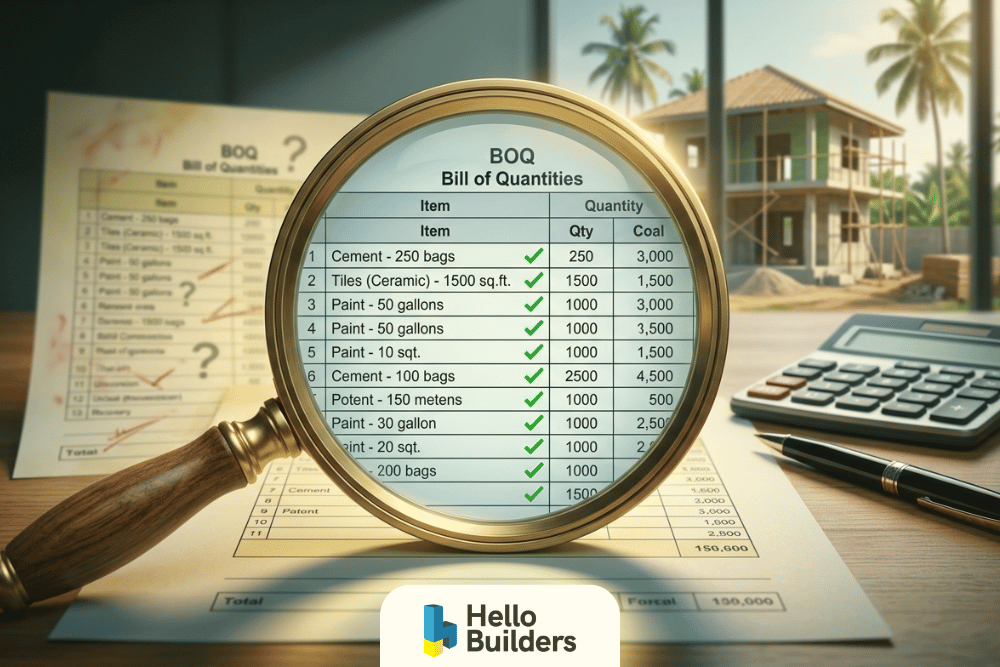
A BOQ, or Bill of Quantities, is a detailed document prepared for construction projects that lists all the materials, parts of work, and labor needed to complete a house. It serves as a roadmap for both the homeowner and the contractor, helping to estimate costs and plan the construction process effectively.
What a BOQ Shows:
- Items of work: Every task involved in building your house, from foundation work to painting.
- Quantities: The exact amount of materials or labor required, such as cubic meters of concrete or square meters of tiles.
- Units: Standard units like meters, square meters, or numbers to measure each item.
- Rates and Costs: The cost assigned to each item, which helps calculate the total project budget.
Why It Matters for Fairness and Transparency:
A well-prepared BOQ ensures that both you and your contractor have a clear understanding of what is included in the project. It prevents misunderstandings, hidden costs, or overcharging.
By having all items, quantities, and prices clearly listed, the BOQ makes it easier to compare quotes, track progress, and confirm payments only for verified work. This transparency helps protect your investment and ensures the construction process is fair for everyone involved.
Step 2: Gather the Key Documents Before You Begin
Before you start auditing your contractor’s BOQ, it’s important to have all the necessary documents on hand. The following are the documents you need to gather to get a clear picture of the project scope and make it easier to cross-check the BOQ.
- House Plans and Drawings: These show the layout, dimensions, and structure of your house. Use them to verify that all items in the BOQ match the actual design.
- Specifications and Materials List: This list details the type and quality of materials to be used, such as tiles, paint, wood, or concrete. It helps ensure the BOQ uses the right materials at the correct quality.
- Contractor’s BOQ: This is the main document you’ll be auditing. Make sure you have the latest version provided by your contractor.
- Contract Agreement: Your signed contract shows the agreed terms, payment schedule, and scope of work. Comparing it with the BOQ can highlight any inconsistencies or missing items.
- Any Earlier Estimates or Quotations: If you received prior quotes or estimates, keep them handy. They help you compare costs and check for unusual differences in the current BOQ.
Having all these documents ready ensures your BOQ audit is accurate, thorough, and effective, and it sets a solid foundation for transparency in your construction project.
Step 3: Check That All Items from the Plan Are in the BOQ
Once you have all your documents, the next step is to make sure every item from your house plans appears in the BOQ. This ensures nothing is missed and reduces the risk of unexpected costs later.
Here’s what you need to do in general:
a. Line Up BOQ Items With Your Drawings
Go through your BOQ and compare each item with your house plans and drawings. Check that every part of the structure, room, and finishing work is included.
b. Look for Missing Items
Pay attention to areas that are often overlooked:
- Structural Work: Foundation, columns, beams, roof, and slabs.
- Finishing Work: Tiles, paint, doors, windows, and other interior finishes.
- Services: Plumbing, electrical wiring, drainage, and other utilities.
c. Note Anything Missing or Vague
If you find items that are not listed or described vaguely, mark them. Vague descriptions like “as per standard” or “miscellaneous work” can hide extra costs. Clarifying these items with your contractor early helps maintain transparency and prevents disputes during construction.
Step 4: Verify The Quantities
After confirming that all items are listed in the BOQ, the next step is to check whether the quantities are accurate. This ensures you only pay for the work and materials actually needed for your house. So, follow these steps:
a. Compare Measurements With Drawings and Specs
Go through each item in the BOQ and match the quantities with your house plans and specifications. For example, check the length of walls, area of floors, or volume of concrete.
- Check Important Numbers
Focus on critical measurements such as:
- Lengths of walls or beams
- Floor and roof areas
- Volume of concrete, sand, or other bulk materials
- Flag Differences That Don’t Make Sense
If a quantity seems unusually high or low compared to the plan, note it. For example, a wall listed as 50 m² when your drawings show 30 m² is a red flag.
d. Watch for Quantities That Seem Too High
Overstated quantities are one of the most common ways costs increase unexpectedly. Highlight anything that looks inflated and ask the contractor to explain.
Verifying quantities carefully helps prevent overpaying and ensures that your construction budget stays accurate and fair.
Step 5: Look At How Things Are Priced
Once you’ve checked the quantities, it’s important to examine how each item is priced. Correct pricing ensures your BOQ reflects fair market rates and prevents hidden costs.
To examine how each item is priced:
- Check the Units: Make sure each item uses the correct unit of measurement, such as square meters (m²), cubic meters (m³), or numbers. Wrong units can lead to incorrect calculations and overpayment.
- Verify the Rates: Compare the rates in the BOQ with current market prices in Sri Lanka. If a rate seems unusually high or low, it may indicate a mistake or an attempt to inflate costs.
- Ask for Breakdowns: For any item with a questionable rate, request a detailed breakdown. This should include material, labor, and any other costs involved.
- Compare Similar Items: Look at similar items in the BOQ to check for consistency. For example, tiles of the same type should have the same unit rate across all areas. Differences could signal errors or hidden charges.
Careful review of pricing helps maintain transparency and ensures you are paying fairly for every part of your construction project.
Step 6: Check That the BOQ Uses Clear Descriptions
A BOQ is only useful if each item clearly explains the work or materials it covers. Vague descriptions can lead to misunderstandings, extra costs, and disputes during construction. Ensuring clarity at this stage is essential for transparency and smooth project management.
Describe Each Item Clearly
Every item in the BOQ should specify exactly what work is to be done or what material is being used.
For example, instead of simply listing “tiles,” it should mention the type, size, brand, and quantity of tiles. Similarly, for structural work, it should state “reinforced concrete column 300x300 mm using M25 concrete and HYSD steel” rather than a generic term like “concrete column.”
Avoid Vague Terms
Phrases such as “as per standard practice,” “as required,” or “miscellaneous work” should be avoided. These vague terms leave room for interpretation and can be exploited to add extra charges later. Clear, specific descriptions make it easy to verify that the work has been done according to your plan and contract.
Benefits of Clear Descriptions
- Prevents Hidden Costs: When items are described clearly, contractors cannot charge for additional work that was not agreed upon.
- Simplifies Verification: Clear descriptions make it easier to check quantities, quality, and completion of work on-site.
- Supports Dispute Resolution: If any disagreements arise, a well-documented BOQ with specific item descriptions serves as strong evidence.
- Enhances Budget Accuracy: Detailed items allow you to track costs precisely and compare them with estimates or market rates.
Taking the time to review and ensure that all BOQ items are clearly described protects your investment and keeps the construction process fair and transparent from start to finish.
Step 7: Make Sure All Types of Work Are Covered
When auditing a BOQ, it’s important to confirm that all parts of your house construction are included. Missing any of the following sections can lead to extra costs later, so check carefully.
- Preliminaries: This includes site setup, mobilization, temporary facilities, and basic preparations before construction begins.
- Foundation and Structure: Ensure all work for the foundation, columns, beams, slabs, and other structural elements is listed.
- Walls and Masonry: Check for brickwork, blockwork, plastering, and any other wall construction tasks.
- Roofing: All roofing work, including trusses, sheets, tiles, or waterproofing, should be included.
- Finishing Work
Items like floor and wall tiles, paint, doors, windows, and cabinetry must be accounted for. - Plumbing and Drainage: Ensure water supply lines, drainage pipes, and sanitary fixtures are included.
- Electrical Work: Check wiring, switchboards, lighting, and other electrical installations.
- Contingencies: A 5–10% buffer for unexpected costs should be included in the BOQ to cover minor changes or surprises during construction.
Verifying that every type of work is included helps prevent overlooked items and ensures your BOQ accurately reflects the full scope of your house project.
Step 8: Compare the BOQ With Other Quotes or Market Rates
Once you have checked the items, quantities, and pricing in the BOQ, the next important step is to compare it with current market rates and other quotes. This ensures that the costs listed are fair and realistic, and helps you avoid overpaying for materials or labor.
To compare your BOQ with market rates:
a. Get Quotes From Local Material Suppliers
Visit or contact suppliers in your area to find out the current prices of key construction materials, such as cement, sand, bricks, tiles, timber, and paint. Make a list of these prices to compare with the rates listed in the BOQ. This will help you identify any items that are priced significantly higher than the market standard.
b. Check Current Sri Lankan Construction Rates
Construction labor rates can vary depending on the region, skill level, and project type. Research standard labor rates for masons, carpenters, plumbers, and electricians in Sri Lanka. By comparing these rates with the BOQ, you can verify whether the contractor’s charges are reasonable.
c. Compare With Other Contractors if Possible
If you have access to BOQs or quotes from other contractors for similar projects, compare them with your current BOQ. Look for significant differences in material costs, labor rates, or quantities. Consistent discrepancies may indicate overpricing or errors in your contractor’s BOQ.
Benefits of Comparing Rates
By comparing your BOQ with market rates and other quotes, you can:
- Identify inflated pricing or unusual cost variations.
- Negotiate better rates with your contractor.
- Ensure that your construction budget is realistic and transparent.
- Avoid unexpected expenses during the project.
Regularly checking rates throughout the project also helps you maintain transparency and ensures that payments are made only for work done at fair market prices.
Step 9: Check How Changes and Extras Will Be Paid
During construction, changes or extra work may arise, such as modifying a room layout, upgrading materials, or adding features not in the original plan. It’s important to manage these properly to avoid unexpected costs.
Here are some tips to deal with kind of a situation:
a. Ensure the Contract Covers Variations
Before construction begins, confirm that your contract clearly explains how variations or additional work will be handled. This should include:
- How extra costs are calculated
- How approvals are given
- Any limits on additional work without renegotiation
b. Written Approval is Essential
The contractor should never add costs or start extra work without your written consent. Verbal agreements can lead to disputes later, so always document approvals for any changes.
c. Track All Changes With Signed Documents
Maintain a record of every variation or extra item. This can include:
- Signed change orders
- Emails confirming agreements
- Updated BOQ entries with clear descriptions and costs
By following this process, you ensure that any additional work is transparent and controlled. It protects your budget, prevents misunderstandings, and guarantees that you only pay for work you have approved.
Step 10: Create Your Audit Checklist
To make your BOQ audit organized and efficient, it helps to use a simple checklist. This ensures you don’t miss any items and can keep track of questions or concerns as you go through the document.
For that, you can:
- Create a Section-by-Section Checklist: Divide the BOQ into sections, such as preliminaries, foundation, walls, roofing, finishing, plumbing, and electrical work. Tick off each section as you review it. This makes it easier to see which parts of the BOQ are complete and which need closer attention.
- Write Short Notes Next to Questionable Items: For any item that seems unclear, has unusual quantities, or uses vague descriptions, jot a quick note beside it. For example, you can mark: “Check unit rate” or “Quantity seems high.” These notes help you remember what needs clarification when discussing the BOQ with your contractor.
- Keep a Separate List for Clarifications: Maintain a running list of items you will ask the contractor to explain. Include details such as item number, description, and your concern. This list ensures that all questions are addressed systematically and nothing is overlooked.
Using an audit checklist helps you stay organized, reduces mistakes, and makes discussions with your contractor more productive. It is a practical tool to maintain transparency and control over your construction costs.
Step 11: Ask For Clarifications
After reviewing the BOQ and creating your audit checklist, the next step is to communicate your questions clearly with your contractor. This ensures that everything is transparent and avoids misunderstandings.
Below are some tips to keep in when you are asking for clarification:
- Share Your Questions in Writing: Provide your contractor with a list of items you want clarified. Sending it in writing (via email or a formal letter) ensures a clear record of what was requested.
- Request Written Explanations: Ask the contractor to respond in writing for each point. Written explanations prevent miscommunication and provide evidence in case of future disputes.
- Keep All Responses for Your Records: Store all replies, documents, and email exchanges carefully. This helps you track decisions, changes, and agreements throughout the construction process.
- Build Trust and Transparency: Good and detailed responses from the contractor show professionalism and accountability. This not only helps you understand the BOQ better but also builds a foundation of trust for the entire construction project.
Step 12: Get Expert Help if You Need (Optional)
Even after reviewing the BOQ carefully, some items or pricing may still be unclear. In such cases, getting professional help can ensure your audit is accurate and that you’re not overcharged.
Consider Hiring a Professional, like:
- Quantity Surveyor: Experts in BOQs, measurements, and construction costs. They can verify quantities, rates, and calculations.
- Civil Engineer: Can check structural items and technical aspects to make sure everything is realistic and safe.
- Independent Auditor: Offers an unbiased review of the BOQ and helps identify any inconsistencies or inflated pricing.
Why Experts Help
- They provide professional assurance that the BOQ is accurate.
- They can identify hidden costs or mistakes that might be overlooked by a homeowner.
- Their advice helps you negotiate fair rates and avoid paying for unnecessary work.
While hiring an expert is optional, it can be a valuable investment for larger or more complex house construction projects, giving you confidence that your budget and BOQ are reliable.
Step 13: Keep All Records and Notes In One Place (Organize All Your Records)
A well-organized record system is essential when auditing your contractor’s BOQ. Keeping everything in one place makes it easier to track costs, review decisions, and avoid confusion during construction.
- Organize Your BOQ Files: Keep both soft copies and printed copies of the latest BOQ. If there are revised versions, label them clearly with dates so you can track changes over time. Avoid mixing old and new versions, as this can lead to payment mistakes.
- Store Your Notes and Comparisons: Keep your audit checklist, comparison sheets, and supplier price checks together. If you compared market rates or received other quotations, file them with your BOQ documents. This makes it easier to refer back to them when discussing costs with your contractor.
- Save All Contractor Responses: Maintain copies of all emails, letters, signed variation orders, and approvals. These documents act as proof of agreements and help resolve disputes if they arise later.
Why Proper Organization Matters
When it’s time to release stage payments or the final payment, organized records allow you to:
- Confirm that work matches the BOQ.
- Verify approved changes and extra costs.
- Avoid paying twice for the same item.
- Settle payments confidently and correctly.
Good record keeping protects your budget and ensures transparency throughout your house construction project.
Step 14: Review During Construction
Auditing the BOQ should not stop once construction begins. Regular checks during the building process help ensure that the work matches what was agreed and that payments are fair.
- Check That Work Done Matches the BOQ Items: As each stage of construction is completed, compare the actual work on site with the items listed in the BOQ. For example, confirm that the type of materials used, the size of structures, and the quality of finishes match what is written. If something looks different, raise it immediately.
- Tie Payments to Work Completed: Avoid paying in advance for work that has not yet been done. Each payment should match the progress on site. Before releasing stage payments, verify that the corresponding BOQ items have been completed as specified.
- Verify Progress Regularly: Make it a habit to review progress at key stages such as after foundation work, roofing, and finishing. This helps you confirm that quantities remain accurate and that no unauthorized changes are added.
Regular review during construction keeps the project transparent, prevents disputes, and ensures that your BOQ remains a reliable guide throughout the entire build.
Step 15: Final Check Before Paying Final Bill
Before making the final payment, carry out one last careful review of the BOQ and all related bills. This step ensures that you only pay for work that has been properly completed and approved.
Make sure to check everything below before paying your final bill:
- Review the Final BOQ and Invoices: Go through the final BOQ version and compare it with the invoices submitted by the contractor. Check that all billed items match the agreed quantities, rates, and approved variations. Make sure calculations are correct and totals are accurate.
- Confirm No Unauthorized Extras Were Added: Verify that no additional items have been included without your written approval. Cross-check with your signed variation orders and written confirmations. If you see any unfamiliar charges, ask for clear proof and documentation before proceeding.
- Inspect the Completed Work: Before releasing the final payment, inspect the house carefully. Ensure that all work listed in the BOQ has been completed to the agreed standard. If possible, prepare a small list of minor defects or unfinished items and ensure they are corrected.
- Pay Only for Verified Work: Release the final payment only after confirming that all work is completed, documented, and approved. Holding back payment until verification is done protects you from future disputes and ensures accountability.
A proper final check gives you confidence that your construction project has been completed fairly, transparently, and according to the agreed BOQ.
Common Red Flags to Watch For
When auditing your contractor’s BOQ, certain warning signs may indicate errors, hidden costs, or a lack of transparency. Identifying these early can save you from serious financial problems later.
Some common red flags to watch for include the following:
- Missing Items That Should Be There: If important elements from your drawings are not listed in the BOQ, this is a major red flag. Missing items often appear later as “extra work,” which increases your total cost. Every structural, finishing, and service item should be clearly included.
- Vague Descriptions: Descriptions that are unclear or too general can hide extra charges. Terms like “miscellaneous works” or “as required” do not clearly explain what is included. Each item should clearly state the material type, size, quality, and scope of work.
- Quantities Much Higher Than Calculated: If the quantities in the BOQ are significantly higher than what your drawings show, this may indicate overestimation. Overstated quantities directly increase your total project cost.
- Prices Far Above Market Rates: Rates that are much higher than current Sri Lankan market prices for materials or labor should be questioned. While small variations are normal, large differences need proper justification.
- No Breakdown for Lump Sum Items: Lump sum amounts without a detailed breakdown make it hard to know what you are paying for. Always ask for a clear split of material, labor, and other costs.
- Contractor Refuses to Explain Costs: If the contractor avoids giving written explanations or becomes defensive when questioned, this is a serious concern. A professional contractor should be willing to explain pricing and quantities clearly.
Being alert to these red flags helps you maintain control over your construction budget and ensures your BOQ remains transparent and fair throughout the project.
Need Help on Building Your Dream Home?
At Hello Builders, we specialize in turning your vision into reality with high-quality construction, modern designs, and expert project management. From luxury villas to contemporary homes, we handle every step of the process with professionalism and attention to detail.
Here’s why Hello Builders is the trusted choice for homeowners in Sri Lanka:
- Expertise & Quality: We use certified materials and follow best practices to ensure your home is safe, durable, and stylish.
- Comprehensive Services: Architectural design, structural engineering, interior solutions, council approvals, and full project management(all under one roof).
- Customer-Focused Approach: We work closely with you to bring your dream home to life while respecting your budget and timeline.
Take the first step toward your perfect home today. Click below to get in touch with our team!
| Contact Us |
Final Thoughts
Auditing your contractor’s BOQ may seem time-consuming, but it is one of the smartest steps you can take when building a house in Sri Lanka. A carefully reviewed BOQ protects your budget, reduces the risk of hidden costs, and keeps the entire construction process transparent.
By checking items, verifying quantities, reviewing pricing, asking for written clarifications, and monitoring progress throughout the build, you stay in control of your investment.
Remember, a clear and accurate BOQ is not just a technical document, but also it is your financial protection tool. When you approach it with attention and proper checks, you can move forward with confidence, knowing that you are paying fairly for quality work and that your dream home is being built on a solid foundation of trust and transparency.
Key Takeaways
- A BOQ lists all construction items, quantities, units, and rates, making it the foundation of your house budget.
- Always collect your house plans, specifications, contract agreement, and all quotations before auditing the BOQ.
- Cross-check every item in the BOQ with your drawings to ensure nothing is missing.
- Verify quantities carefully to avoid paying for inflated measurements.
- Compare unit rates with current Sri Lankan market prices for materials and labor.
- Make sure all descriptions in the BOQ are clear and specific to prevent hidden costs.
- Confirm that every category of work, from preliminaries to electrical and plumbing, is included.
- Require written approval for any changes or extra work before additional costs are added.
- Keep all records, notes, and contractor responses organized for easy tracking and payment control.
- Conduct a final review before releasing the last payment to ensure you only pay for verified and completed work.
FAQs
What are current material rates in Sri Lanka for BOQ?
As of early 2026, typical rates include cement at LKR 1,800-2,200 per bag, TMT steel bars at LKR 220-250/kg, and river sand at LKR 12,000-15,000 per cubic meter; always verify with local suppliers like Lafarge or Tokyo Cement.
Do I need a quantity surveyor for BOQ audit Sri Lanka?
Yes, hiring an independent QS registered with the Institute of Quantity Surveyors Sri Lanka (AIQS) is recommended. They cross-check rates against SMM7 standards and market data for unbiased validation.